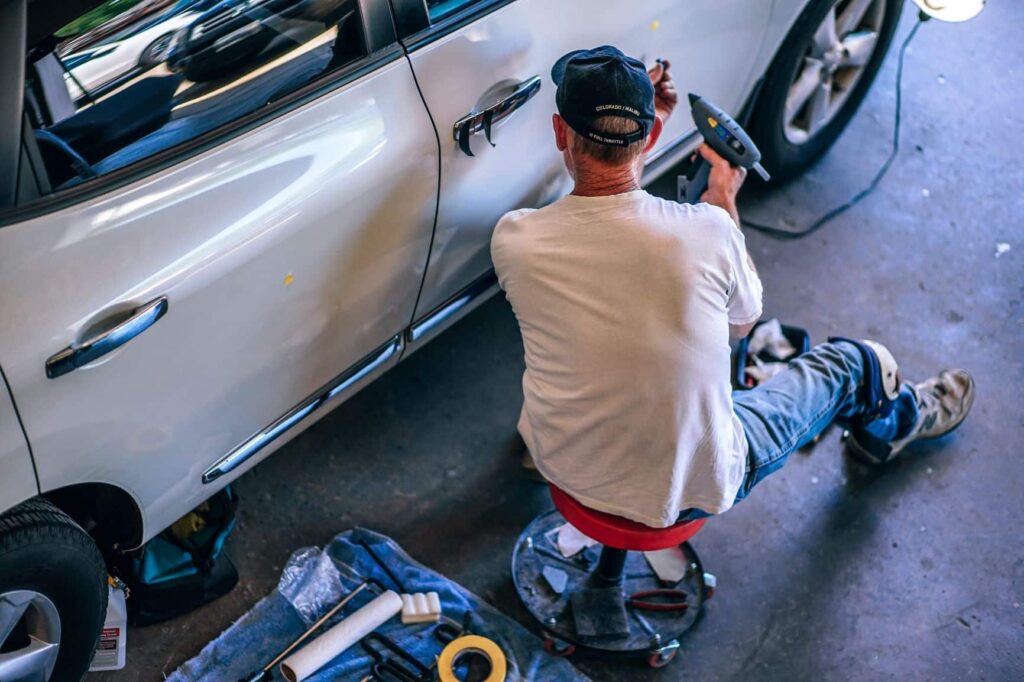
Scratches, dents, roughness, rust… The bodywork is the most vulnerable part of the car, and for good reason: it’s the first to suffer from external shocks. While some drivers pay little attention to the exterior condition of their vehicle, others enjoy driving a car with flawless bodywork and no blemishes.
Whether you belong to one group or the other, your body will be scrutinized during the technical inspection. It’s best to keep it in good condition to avoid unpleasant surprises!
Step 1: Identify the problem
Different problems require different treatments!
The bodywork can be damaged in various ways:
- Is it scratched? What is the width of the scratch? Is the paint faded?
- Is it dented? What is the diameter of the dent? Is the dent accessible from the inside?
Depending on the type and depth of the impact on your body, you will need to apply a specific treatment or several successive treatments.
Case 1: Your body is scratched
You had a little mishap and your body is scratched. So, you want to fix it without calling a professional.
Many products are available today to conceal the scratch:
- Touch-up pen: For small touch-ups, a touch-up pen allows you to go over a slight scratch to seal and protect your body. It’s a very simple solution to use and has the advantage of being inexpensive. You just need to make sure to buy a pen that matches the color of your bodywork. Apply it to the scratched area, pressing firmly. Once done, let it dry for several hours, then sand the treated area if necessary.
- Scratch remover: Convenient and effective, scratch remover is a product that is applied to the scratched area to erase the marks. This treatment can be used to fill and conceal small to medium scratches. To apply it well, wear a cloth, then apply the scratch remover to the area to be treated. Using the cloth, spread the product evenly, then let it dry for about 30 minutes. Once dry, wipe and polish the product with a soft, clean cloth.
- Comprehensive treatment: In the case where the scratch is deep (paint and varnish removed), it is best to apply a multi-step treatment. First, use fine-grit sandpaper to clean any paint chips that may be present on the body. Then, apply the touch-up pen or scratch remover according to the manufacturer’s instructions. Once the product is dry, polish with a soft, clean cloth and buff.
Case 2: Your body is dented
Following a collision, your bodywork may have dents. Not only is this not very aesthetic, but it also negatively impacts the value of your vehicle. While we recommend calling a specialist for a better result, it is still possible to straighten your body yourself with minimal tools:
- With a suction cup: As simple as it may seem, this method is not always effective and involves using a suction cup to pull the dent. Using a lubricant such as petroleum jelly allows for better suction of the cup on the body around the dent. By suction, the cup will help restore your body to its original state. Retry the operation several times, crossing your fingers for a good result.
- With a hairdryer: Temperature changes expand metal. By using this phenomenon to your advantage, it is possible to remove dents from the body. The principle is simple: heat the dent to the highest possible temperature, for example, using a hairdryer. Once the maximum temperature is reached, cool the area of the dent with a can of compressed air (ideally), or a bucket of very cold water (at worst). The thermal shock due to the large temperature variation will bring the sheet metal back to its original shape. Evidence in video.
- With a hammer: If you can access the dent from the inside, you may be tempted to use a hammer to push out the dent. This rustic method should be approached with caution. If possible, use a rubber mallet to avoid damaging the sheet metal. Then, place a metal plate on the side opposite to where you will be hitting. Finally, tap with small, close-up strikes. There’s no need to hit hard as this may deform the sheet metal. By taking your time and all necessary precautions, you will achieve a satisfactory result. All you have to do is apply the finishing touches to eliminate scratches and varnish the body.
There are also many tools and dent repair kits available online. These allow for better results but require a certain investment. For example, you will find this complete dent repair kit from the brand Mookis sold for €42.99 on Amazon. The equipment used by professionals is much more expensive: expect to pay €199 for an inertial suction hammer, and at least €500 for a straightening station.
In general, we recommend hiring a professional to work on your bodywork, especially when it comes to major or delicate repairs. Body shops have the right tools and expertise that guarantee a better result than a basic repair. On average, a repair at a body shop will cost you between €40 and €70 per hour excluding VAT depending on the complexity of the intervention. Note that there is no obligation when requesting a quote, so you can consult several body shops to compare prices, then decide whether to use a professional’s services or do the work yourself.
Bodywork at VPauto
When a new vehicle arrives with us, its bodywork is systematically analyzed by our experts, who create a report. Not only does this provide maximum transparency to customers about the vehicle, but it also allows for an accurate estimation of a vehicle’s value and thus adjust its starting price.
An example of a bodywork report as found on the vehicle’s caps:
You will have no excuses when you see a vehicle that interests you, but its bodywork needs to be revised!
Tag: how to become a bodyworker