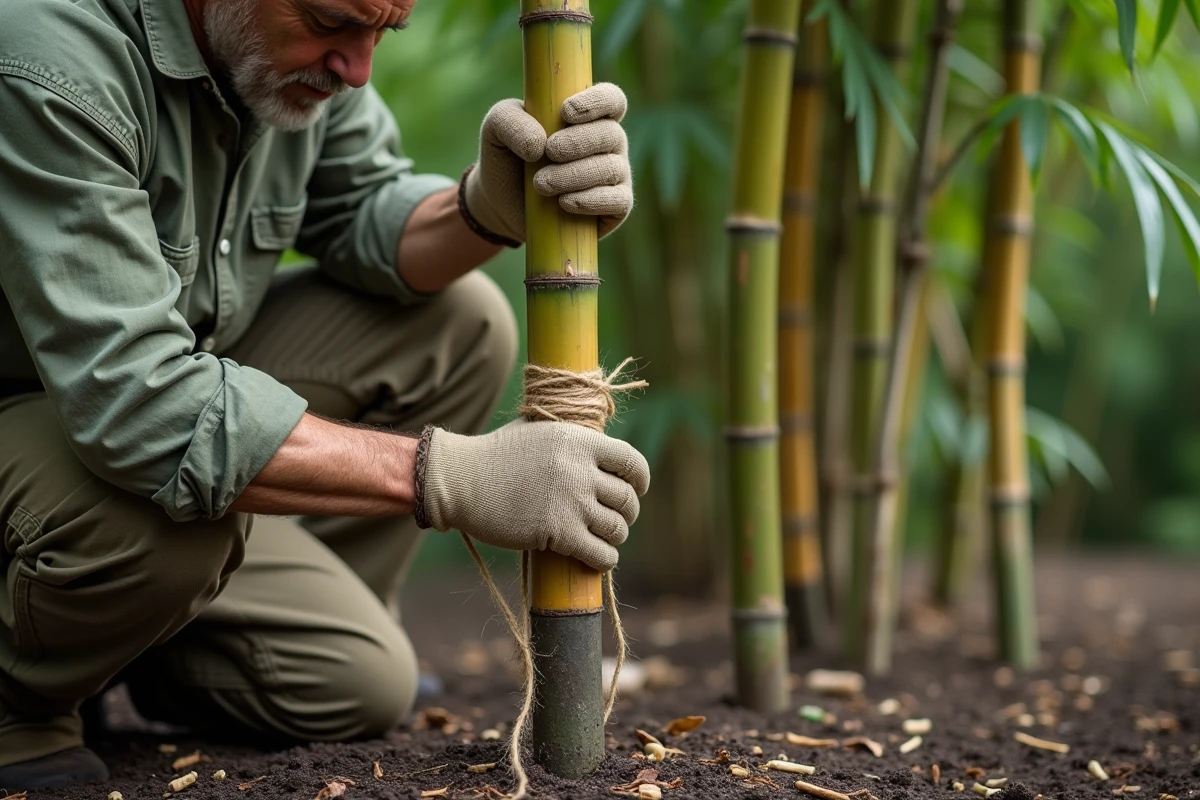
A bamboo planted straight into the ground often ends up leaning, twisting, or coming out of its spot after a few weeks. The problem does not stem from the bamboo itself, but from how it is secured to the ground. Firmly anchoring bamboo in your garden requires understanding two things: the hollow nature of the stem and the behavior of the soil under the effects of wind or rain.
Collar rot: the invisible trap when planting bamboo in the ground
Before discussing anchoring, we need to address a problem that most tutorials overlook. When a dry bamboo is driven directly into the ground, the contact area between the soil and the air (the collar) accumulates moisture. The bamboo rots precisely at this spot, sometimes in just a few months.
Bamboo fiber has no natural resistance to prolonged contact with damp soil. Unlike treated solid wood, dry bamboo rots first at its buried base. You can tighten, tie, or anchor it, but if the stem breaks at ground level, the entire setup collapses.
To protect this area, two approaches work. The first is to coat the buried part (and the first ten centimeters above ground) with linseed oil or a plant tar. The second, more reliable method, avoids any direct contact between the bamboo and the soil by using an intermediate metal support. This is where anchor stakes come into play.
If you’re looking to understand in detail how to anchor bamboo to the ground according to the type of project (fence, pergola, stake), the logic remains the same: isolate the base of the bamboo from soil moisture before securing anything.

Helical stake and plate: securing bamboo to the ground without concrete
In recent years, helical stakes (also known as foundation screws) have emerged as an alternative to concrete sealing for lightweight garden structures. The principle is simple: a metal screw that is driven into the ground by rotation, topped with a plate or sleeve.
Why this method is particularly suitable for bamboo
Bamboo is hollow. Screwing or nailing into it almost certainly splits it. A helical stake circumvents the problem: the bamboo slides into the sleeve or is bolted onto the plate, without piercing the stem itself.
The helical stake keeps the bamboo out of the soil, eliminating collar rot. The structure remains removable, a valuable advantage if you change your garden layout from season to season.
This solution is particularly recommended for rocky or very compact soils, where driving bamboo deep would require disproportionate effort. You drive the screw with a lever bar, place the bamboo, and you’re done.
Limitations to be aware of
The diameter of the sleeve must match the diameter of the bamboo. If it’s too wide, the bamboo moves. If it’s too tight, you risk splitting the stem by forcing it. Plan to use a rubber or cork wedge between the metal and the bamboo to absorb vibrations caused by the wind.
Bracing and tying: securing bamboo with rope
Bracing is the oldest and most versatile technique for assembling bamboo together or securing it to an already anchored post. It requires only a strong rope and a bit of method.
Choosing the right rope for outdoor use
Have you ever noticed that a standard garden twine disintegrates after a winter? For durable bracing, the choice of rope makes all the difference. Here are reliable options:
- Natural hemp rope offers good grip on bamboo and resists UVs fairly well, but it eventually rots if it remains constantly wet.
- Polypropylene rope is water and mold resistant. It slips more on the smooth surface of bamboo, requiring tighter knots.
- Galvanized wire, twisted in double strands, supports heavier loads. It is suitable for fences or barrier posts but can gouge the bamboo if the tension is excessive.
Achieving effective bracing in four steps
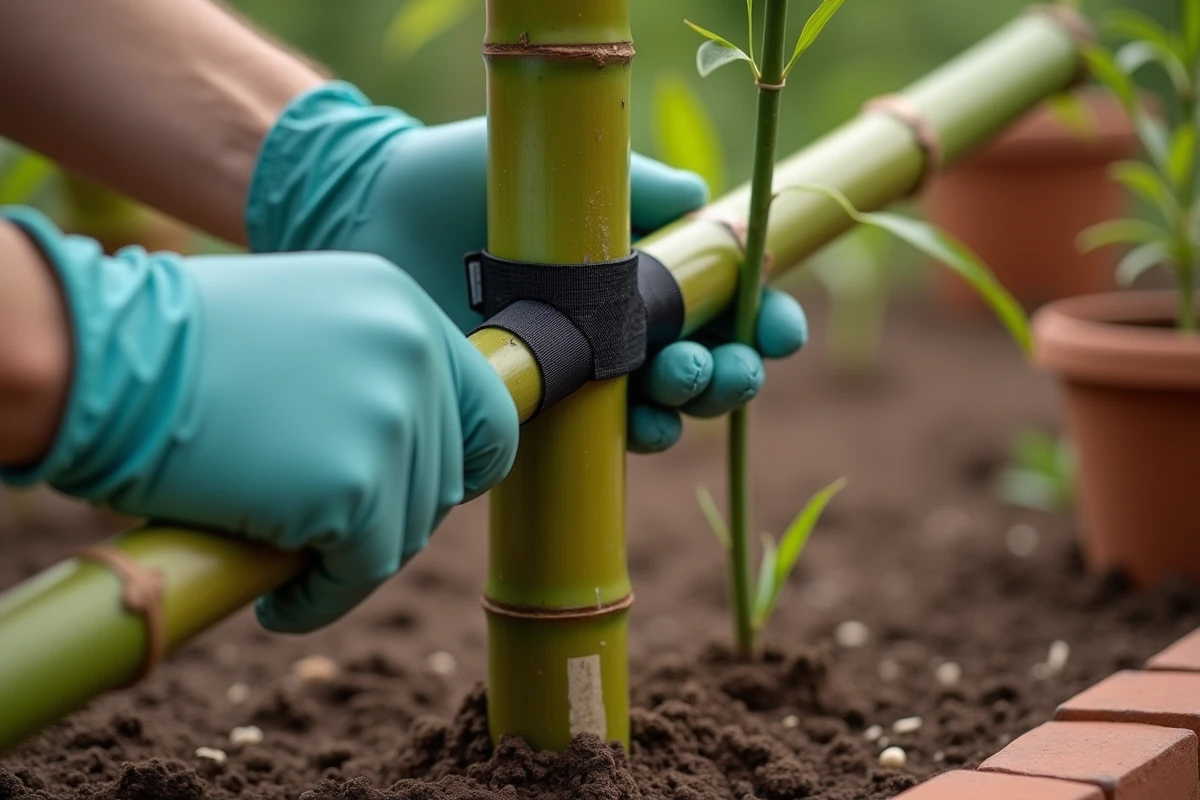
Cross bracing (two perpendicular stems) is based on one principle: alternate the rope passes over and under each bamboo. Start with a fixed knot on the first stem. Pass the rope under the second, come back over the first, and repeat this crossing four to five times.
Finish with tightening turns (called “frappe”) between the two bamboos, perpendicular to the previous passes. The frappe compresses the rope turns and locks the assembly. Without this step, the bracing loosens within a few days due to vibrations.
Ground anchoring for bamboo fence: posts and light foundation
Securing a bamboo fence differs from simply staking a tomato plant. The wind exerts continuous lateral pressure, and the surface area of grip is much larger.
The most common setup combines load-bearing posts (made of treated wood or metal) driven deep into the ground, to which horizontal bamboos or panels are secured by bracing or stainless steel collars. The load-bearing posts bear the force, not the bamboos themselves.
For the posts, two options for light foundations work well:
- Drive the post into a form tube filled with lean concrete, to a depth of at least one-third of the total height of the post.
- Use a helical stake suitable for the diameter of the post, with no excavation.
- In clay soil, add a gravel bed at the bottom of the hole to prevent water from stagnating around the base.
The bamboo fence is then secured to the posts with galvanized wire or stainless steel ties. Avoid drilling into the bamboos to insert screws: drilling a dry bamboo causes longitudinal cracks that weaken the entire stem.
Which bamboo species withstands outdoor conditions best
Not all bamboos are equal as construction material in the garden. Horticulturists who sell both hedge bamboos and stakes recommend distinguishing between thick-walled species, which are more resistant to bending and wind, and thin-walled species that break easily under stress.
A bamboo stake intended to remain in place for several seasons must have a sufficiently dense wall to support the ties without splitting. Favor stems harvested at maturity (several years of growth) and dried slowly. A bamboo cut too young or dried too quickly will crack at the first tightening of the rope.
The choice of the right stem, combined with a fastening method that avoids direct contact with damp soil, makes the difference between a setup that lasts a season and an assembly that endures for years. Where many projects fail, it is neither the rope nor the stake that is at fault, but the bamboo itself, poorly chosen or poorly prepared.