
Giving a math lesson to a high school student or helping an adult improve their English does not require any mandatory diploma in France. The profession of private tutor is open to anyone capable of imparting knowledge, provided you choose the right administrative framework and structure your offer. This guide details the concrete steps to get started, whether you are considering home tutoring or online teaching.
Preparing a solid first lesson
Before thinking about legal status or pricing, ask yourself a simple question: what specific niche will you teach? A student in an engineering school offering tutoring in physics-chemistry for the baccalaureate has a different positioning than a professional musician giving guitar lessons to adults.
Defining a subject and a target level allows you to formulate a clear offer. Platforms like Superprof list over 500 subjects, which means competition is broad. The more specific your niche is (for example, preparation for entrance exams to business schools, or conversation in Spanish for travelers), the more you stand out.
Next, prepare a sample lesson. Write a one-hour session plan with a single educational objective, two or three exercises, and a summary at the end of the session. This preparatory work reassures your first students and gives you confidence. It is also possible to become an online tutor with Home Educ to structure this process from the start.
Micro-entrepreneur status for private tutoring: what you need to know
The vast majority of beginner private tutors choose the micro-enterprise regime. This status offers several concrete advantages for testing the activity without heavy financial risk.
- The annual revenue ceiling is set at 77,700 euros for service provision, which leaves a comfortable margin even in case of high activity.
- The VAT exemption applies under certain conditions, simplifying invoicing: you do not charge VAT to your students.
- A exemption from CFE in the first years is possible, a welcome relief when starting with low income.
Registration is done online at the INPI’s single window. Allow a few days to obtain your SIRET number. You can then issue invoices and receive your first payments.
Combining a salaried job and private tutoring
Are you already employed, for example in the National Education system or in a company? Combining it with a private tutoring activity in a micro-enterprise is legally possible. However, check your employment contract: non-competition and loyalty clauses may limit the volume or type of lessons you provide.
A public school teacher must also comply with the rules for combining activities specific to the public service. Failure to comply with these obligations can lead to disciplinary sanctions.
Diploma and skills: what platforms really expect
No diploma is legally required to give private lessons in France. However, platforms and tutoring organizations apply their own selection criteria, and this is where beginners often go wrong.
Some organizations require a Bac+3 level, while others accept Bac+2. The difference has a direct impact if you are a student: with a Bac+2, you can apply on certain platforms but not all. Check the minimum required level before creating your profile to avoid rejection.
Beyond the diploma, pedagogical skills matter more in practice:
- Being able to adapt the pace of a lesson to the actual level of the student, not their theoretical level.
- Formulating an explanation in three different ways when the first one does not work.
- Keeping a written record of progress to show parents (or the adult student) the concrete evolution.
A second-year math student who masters these three points will often be more effective than a master’s degree holder who recites a lecture.

Home tutoring or online teaching: decide based on your situation
The choice between home and video conferencing is not just a matter of comfort. It changes your catchment area, your pricing, and your daily organization.
At home, you are geographically limited. The travel time between two students reduces the number of lessons you can conduct per day. In return, direct contact facilitates the follow-up of younger students (elementary, middle school) who disengage more quickly behind a screen.
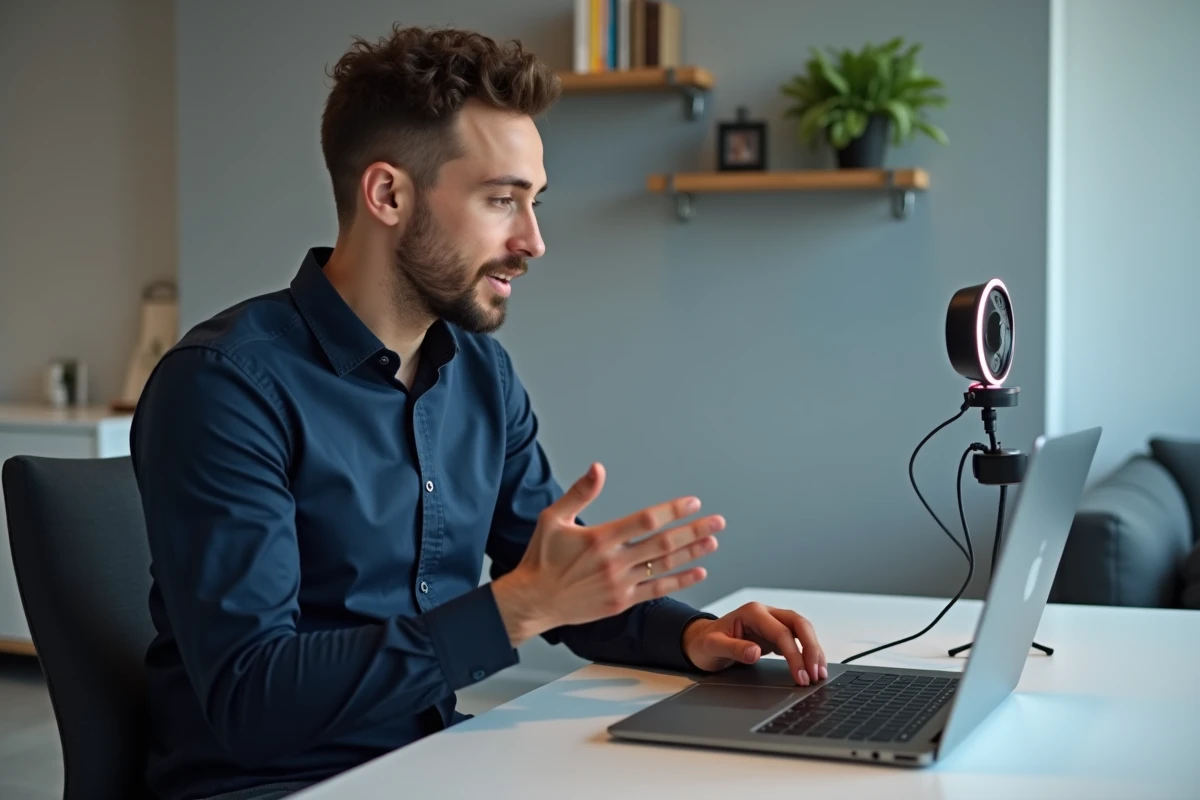
Online, your market becomes national, even Francophone. A teacher based in Toulouse can teach French to an expatriate in Montreal. Video conferencing tools (shared whiteboard, screen sharing, session recording) partially compensate for the physical absence. For subjects where writing is paramount (languages, humanities), the online format works just as well as in-person.
Setting a coherent rate when starting out
You do not yet have reviews or a reputation. Offering a slightly lower rate than the local average for your first weeks allows you to quickly attract students. After about ten lessons, positive feedback justifies a gradual increase.
Remember to include preparation time in your profitability calculation. One hour of teaching often requires thirty minutes of preparation when starting out, which changes the perception of the actual hourly rate.
The path to becoming a private tutor boils down to a few well-placed decisions: a specific niche, an appropriate status, a carefully prepared first lesson. The rest is built session by session, adjusting your pedagogy based on your students’ feedback.